
Lincoln City Directory Holdings
Lincoln's historical shelf begins with the 1873 directory era. The Bennett Martin Local History Center reports city-directory microfilm reaching back to that start. Its detailed holdings guide describes an 1873 to 1972 microfilm run and broader 1876 to 2023 holdings, while warning that some years, especially in the 1940s, are unavailable. Those overlapping statements describe formats and holdings, not a promise that every annual issue survives. Ask staff for the exact year before drawing a conclusion from a missing volume.
| Collection | Years | Where Held | Access |
|---|---|---|---|
| Wolfe's Lincoln City Directory | 1873-74 | Early directory catalogs and Lincoln collections | Catalog and historical-collection lead |
| Hoye's Directory of Lincoln City | 1891 | UNL Digital Commons | Digitized scan online |
| Lincoln City Directories on microfilm | 1873-1972 | Bennett Martin Local History Center | On-site microfilm readers |
| Broad Lincoln directory holdings | 1876-2023, with gaps | Lincoln City Libraries | Confirm the volume with staff |
| Lincoln telephone directories | 1928-present; another handout lists 1904-2022 | Bennett Martin | On-site address context |
City directories and telephone books have different inclusion rules. A telephone listing can help bridge a gap, but it is not a substitute for the annual city volume. The library's local genealogy holdings list is the practical check on formats, companion collections, and year limits.
Lincoln City Directories at Bennett Martin
The Local History Center is on the second floor of Bennett Martin Public Library, 136 S. 14th Street. Directories sit alongside newspapers, yearbooks, genealogy sources, cemetery volumes, and Sanborn material. Many items are requested for use in the building. That matters when a household disappears from a directory: a newspaper notice, a yearbook, or a cemetery reference may answer a question that the annual listing cannot.
The Local History Center describes the library's local-history collections and access conditions.
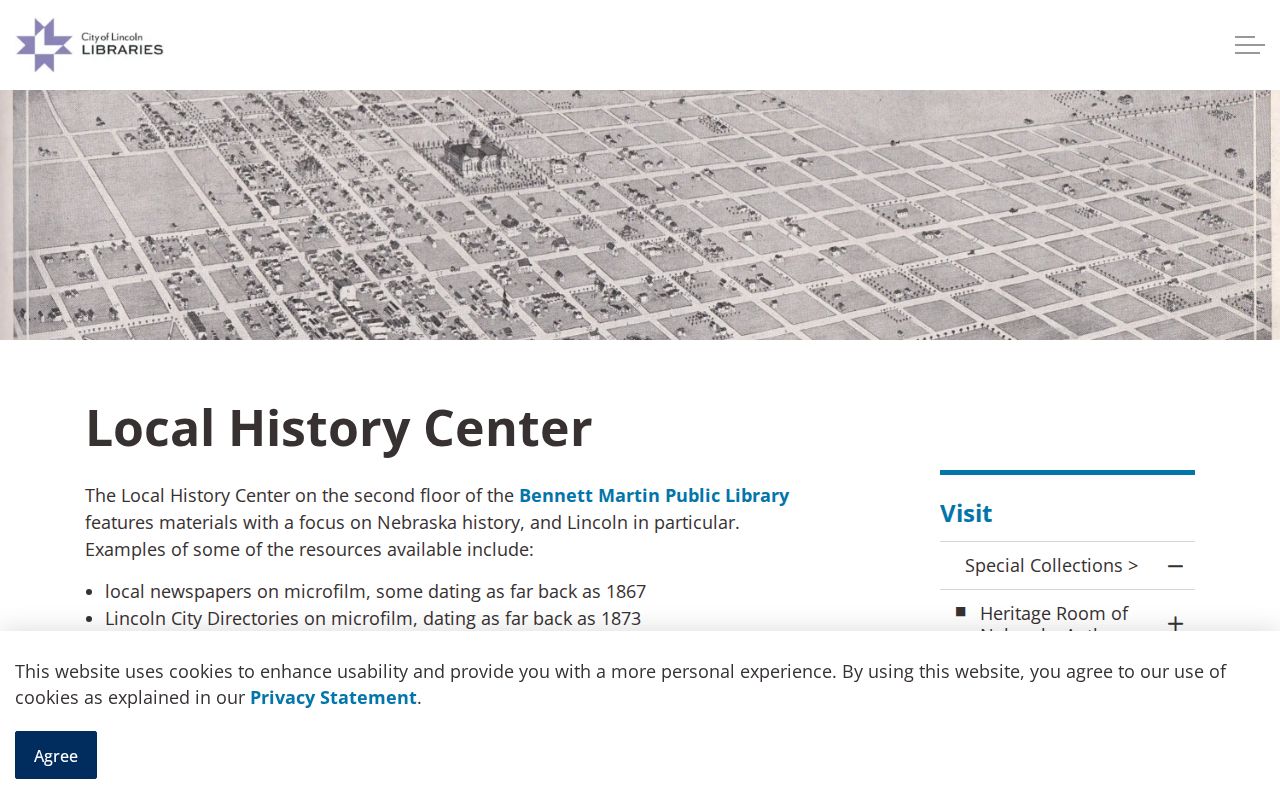
The center's grouped collections make it possible to move from an annual directory entry to newspapers, maps, and family-history sources without assuming they all prove the same thing.
Library facilities also provide free in-library access to Ancestry Library Edition and JUSTICE/SCCALES resources identified on the research databases page. Ancestry Library Edition is an on-site resource, so census work planned from home may need a library visit.
Lincoln Directory Publishers and Years
Early Lincoln volumes did not come from one uninterrupted publisher. Authoritative catalog material identifies J. M. Wolfe for 1873-74, John Zorn for 1876-77, Kent's Directory for 1880-81, and Sam H. Glenn's directory for 1881-82. Hoye's 1891 publication is a separate, digitized source. Later reported runs include Lincoln Directory Company from 1890 to 1917, W. H. Brown for 1917-18, and M. A. Kent from 1918 to 1941. Check the particular Lincoln volume before assuming an issue is available for every year in a publisher's run.
History Nebraska's catalogue preserves H. S. Robinson's History of Lincoln City Directories, which describes a practically complete 1873 to 1941 file assembled in the Historical Society library. Robinson's guide is useful beyond its list of years because it discusses arrangement, growth, adjacent territory, and streets with a key to name changes.
- 1873-74: Wolfe's directory gives the earliest named annual run identified in the local record.
- 1876-82: Zorn, Kent, and Glenn volumes mark several early compilers and publishers.
- 1891: Hoye's volume survives as a UNL digital scan.
- 1873-1941: Robinson documented the nearly complete Historical Society file.
- 1873 onward: Bennett Martin's microfilm and broader library holdings continue the local trail, subject to gaps.
Reading a Lincoln City Directory Entry
A typical entry can give a surname, given name, street address, occupation or employer, and a spouse or household notation. Some volumes include widow abbreviations, owner or renter marks, business listings, street sections, advertisements, and city statistics. Those marks are only useful after reading the front matter. The abbreviation key and arrangement change from volume to volume, so do not assign a meaning to a letter based on a different year.
| Name | The alphabetical resident section may use initials, spelling variants, or a household form. |
|---|---|
| Address | A residence or business address fixes the listing to a particular annual snapshot. |
| Occupation | Work or employer wording can distinguish people with the same name. |
| Household notation | Parentheses, spouse references, estate forms, or widow notation can guide a further search. |
| Street section | A reverse or address-order section may identify occupants when the name is not known. |
- Criss-cross directory
- An address-order section that groups occupants by street and number rather than by surname.
- Householder index
- A listing organized around a household head or address, depending on the specific volume.
- Abbreviation key
- The front-matter explanation of the volume's marks, which should be read before copying a field into notes.
Note: An annual directory records a point in time and does not prove continuous residence between editions.
Lincoln Directories in a Digital Scan
Hoye's 1891 publication is one of the clearest online starting points because the original volume is available through UNL. It is still worth checking the scanned page rather than relying on a search snippet. Page layout, initials, punctuation, and the abbreviation key are part of the evidence.
The digitized Hoye's Directory of Lincoln City is the source for this 1891 scan.
The scan preserves the form of a historical directory, including context that may be lost in a partial text transcription.
Lincoln Directories and Old Street Names
Address searching needs a geography check. University Place agreed to annexation in 1926, followed by street and address changes in 1927. A household that seems to vanish may have remained in place under a new address. Robinson's street-name key, historic city-limit material, and the old and new street names should be used together before deciding a record trail broke.
Historic municipal materials add another local layer. Lincoln-Lancaster County RG301 lists municipal records that include Lincoln Police Court dockets from 1871 to 1922, Havelock dockets from 1909 to 1928, and University Place dockets from 1918 to 1926. They are a historical name trail, not a modern address directory.
Trace a Lincoln City Directory Household
Use the year sequence to test a household history rather than forcing one name into every result. Start from a census, deed, obituary, marriage record, or known address. Search initials, middle names, maiden names, spelling variants, and widow or estate forms. Record the year, exact address, occupation, employer, and household notation before moving to the next volume.
- Find the first plausible annual listing and copy its address and all identifying fields.
- Check adjacent directory years for a move, changed household notation, or omission.
- Use the reverse section when the address is known but the occupant is not.
- Pair directory dates with the released federal census years from 1870 through 1940.
- Check newspapers, probate, burial records, deeds, or dockets to test a suspected transition.
Federal census images are public through 1940 under the release schedule. Ancestry Library Edition is available inside Lincoln City Libraries, and the library lists MyHeritage as another genealogy option. For a modern parcel trail, the Lincoln by-street directory focuses on current address-keyed records rather than rebuilding the historical shelf.
Telephone Directories for Lincoln Gaps
Telephone books can bridge years where a city volume is missing, but they should be labeled as telephone evidence. The two Bennett Martin handouts describe different coverage spans, one beginning in 1928 and another listing 1904 to 2022. That difference is a reason to ask for the specific volume, not to choose the earliest year as a guaranteed continuous run.
Yearbooks, cemetery volumes, newspapers, and Sanborn maps offer different kinds of support. School yearbooks may place a name among classmates; newspapers can report moves, legal notices, or obituaries; Sanborn maps describe a building's footprint and use. None substitutes for a directory entry, and a map does not identify an occupant.
Note: Keep the source type beside each fact so a telephone listing is never mistaken for an annual household directory.
Lincoln Archive Directory Leads
When library material stops, the next stop depends on the question. History Nebraska's county-government records identify Lancaster collections across court, probate, naturalization, and related archives. Bennett Martin's vertical files hold more than 1,300 clipping folders, mainly from Lincoln newspapers of the 1930s through the 1990s, and local researchers can request copies from the Periodicals room.
Not every useful item has a public text search. Bennett Martin's vertical files are available in person, and the library says long-distance researchers may seek reference-by-mail or email copies subject to Ask a Librarian fees. The Potter Research Room at History Nebraska is the place for many government-record reels and finding aids. Use the collection's index or staff help to identify the series first, then request the reel, file, or reproduction route that applies to that material.
Use those sources to corroborate a directory lead, not to make a leap from a shared surname. A move, death, marriage, or changed street name has better support when the annual listing is compared with a dated newspaper item, a deed, or a public probate record.
New Lincoln Microfilm Tools
Lincoln's historical record trail is not entirely online. The Bennett Martin Local History Resource Hub opened in 2024 with directories back to 1873, digitized LPS yearbooks, newspaper and genealogy databases, and Sanborn records. The library's hub announcement describes that combined research space.
History Nebraska's Potter Research Room at 1500 R Street added two digital microfilm scanners during 2025-26. That recent change helps with records that remain most usable on a reel, including local government and newspaper material. A successful name search is often only the first step; the image, context page, or index book may be the record worth saving.